
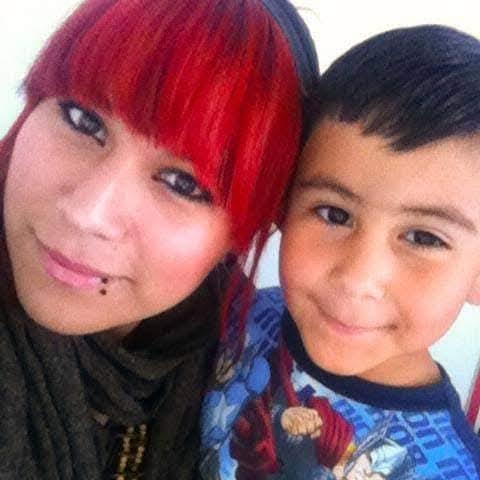
At 20 years old, Ana found herself unexpectedly pregnant. The man she was seeing became absent from her life and pressured her to have an abortion. Her family pressured her as well, and friends warned her that having a baby would change her life.
However, during a pivotal visit to a clinic, everything shifted.
Now 39 years old and living in Arizona with her husband, two children and one on the way, Ana says choosing life for her son was the best decision she ever made.
“I know it’s hard and I know it’s scary. I didn’t know how to take care of a baby when my son was born. But the love that I felt for him since the minute I saw him in that ultrasound was unbelievable,” she says.
A childhood of instability
Ana was born and raised in Morelia, Mexico. After her parents divorced when she was 5 years old, she moved between homes — living with her grandparents, her mother and occasionally her father, though their relationship remained distant.
“He was very smart, and I looked up to him,” Ana says. “But as a father, he wasn’t really there. He wasn’t supportive.”
That lack of a strong father figure, Ana believes, left a lasting impact.
“Those early relationships affect your psyche in the long run,” she explains.
That instability shaped Ana’s adolescence and early adulthood. She worked as a bartender, partied frequently and lacked a strong support system.
“I was very lost,” she says. “I didn’t really have anyone guiding me.”
One doctor’s words changed her future

Ana found out she was 12 weeks pregnant in 2006. She shared the news with her parents a week later. Her mother, influenced by her religious beliefs, opposed abortion. However, during a family discussion that included her mother, father and older sibling, both her father and sibling urged her to have an abortion.
Her father arranged an appointment through a friend who was an obstetrician to explore abortion options, at a time when abortion remained illegal in most of Mexico.
Ana went to the appointment feeling conflicted.
“I really didn’t want to [go], because besides being afraid, I felt that it was wrong,” she says.
What happened next changed everything.
The doctor informed Ana that abortion pills were not an option and that a surgical procedure would be necessary because she was too far along. She says he detailed the procedure, including cervical dilation, fetal dismemberment and physical risks like uterine damage, fatal bleeding and infertility.
Because the doctor could not find the baby’s heartbeat with a doppler, he scheduled Ana for an ultrasound the next day. When Ana saw her baby on the ultrasound, she immediately knew it was not just a “clump of cells” — it was a baby.
Overcome with emotion, Ana started crying. Her mother was waiting for her in the waiting room, and when Ana came out, she told her mom, “I don’t know how hard this is going to be and I don’t care because I’m going to have my baby.”
Navigating life as a single mom

After choosing life for her son, Ana stepped into the unknown. Her pregnancy in 2006 unfolded with minimal support and constant uncertainty. While Ana’s mother expressed excitement, especially after learning she was expecting a grandson, support at home came with conditions. Although her mother helped with essentials, like providing a debit card or later a place to stay, nothing came without strings attached.
Around the fifth month of her pregnancy, the man who denied being the baby’s father returned and asked for forgiveness. Hoping to give her son the stable family she never had, Ana gave her child’s father another chance. But within weeks, he disappeared again — this time for good.
From there, she faced motherhood largely on her own. With no formal assistance programs for single mothers in Mexico, Ana juggled jobs and family obligations just to get by. She lived with relatives, but often under the condition that she work — cooking, cleaning or caring for them.
“Sometimes I had to choose who was going to eat — my baby or myself,” Ana says. “And it was always him. We [experienced] some homelessness also at some point, but we made it through.”
Despite seasons of instability, financial strain and even temporary homelessness, Ana remained steadfast. Through it all, she says her son was her motivation.
“I wish I could tell all those people that told me that he was going to ruin my life that he actually saved me in a lot of ways,” she says. “He gave [me] so much structure and created a path [for] my life.”
Shifting beliefs

Although Ana chose life for her son, her stance on abortion remained uncertain in the years that followed. That perspective began to shift years later when a close family member faced an unplanned pregnancy. The circumstances were difficult — the father had a history of abuse, and the relationship had ended. The family member asked for help, and Ana agreed to accompany her to a clinic in Mexico City.
“There was this girl in front of us bragging how this was her fifth abortion,” she recalls. “And then there was another one behind me talking to another girl about how it was her second [abortion].”
This experience led Ana to reconsider her stance on abortion access. She was troubled to learn that some women were using the procedure as a form of birth control. Studies indicate that contraceptive failure is a common factor, with more than half of abortion patients in 2000 and 2014 reporting they had used birth control when they became pregnant.
Ana says her use of a copper IUD for 14 years also helped shape her current perspective on birth control and abortion access. After giving birth to her son, Ana had an IUD inserted before leaving the hospital as part of a birth control program offered specifically to single mothers.
Her obstetrician had recommended a one-month break from the device, and that is when Ana later conceived her second child with her now-husband. Based on her experience, Ana believes many women today rely on abortion as a fallback instead of taking precautions.
“Accessing abortion has been made so easy,” she says.
A new chapter

After eight years as a single mother, Ana’s life took an unexpected turn.
While still living in her hometown in Mexico, she met her now-husband online, who lived in Phoenix, Arizona. Before introducing him to her son, she says she took time to assess his character. They got to know each other and moved to a border town in 2015 so he could work in Arizona and return home to her and her son each night.
The couple married in 2017 and continued living in Mexico while beginning a long and complex process to obtain U.S. visas. She said her husband crossed the border daily for work for seven years, until the family was finally able to move to the United States.
In January 2022, Ana gave birth to their second son in Arizona. The move to the U.S. marked the start of a more stable life — one built on sacrifice, love and family.
Ana and her husband are expecting another baby. She says her oldest son, now 19 years old, remains her greatest motivation.
“He’s an amazing boy,” she says. “My family was very dysfunctional, and I never felt like I belonged to something. When I had my son, I finally belonged to someone. He has been my rock.”
Ana’s encouragement to those facing an unplanned pregnancy:
“I want women out there to know that motherhood is not supposed to be easy. But it’s very gratifying, and it’s worth it. And even if you don’t want that baby, you can still give that baby the gift of life. I hope my story reaches girls to let them know that it’s not impossible. But even with very limited support around you, it can be done. [My son] knows everything that happened. And I have told him, ‘You were unplanned, but you were never unwanted.’ I had all of these people telling me that it was going to be so hard, and sometimes it’s very easy to listen to other people when you’re scared. But ultimately it was the best decision I ever made.”
Written by Melina Nicole.
Leave a Reply